

Malaysia’s heat does not wait for permission to walk through your front door. At 32°C on a typical afternoon, a ceiling fan placed in the wrong spot is barely better than no fan at all.
Get the placement right and you can feel a 4°C to 8°C drop in perceived temperature without touching your air-conditioner.
This guide walks you through ceiling fan placement for optimal air circulation, room by room, so every spin of the blade actually works for you.
The Foundation: Ceiling Fan Height, Clearance, and Downrod Length
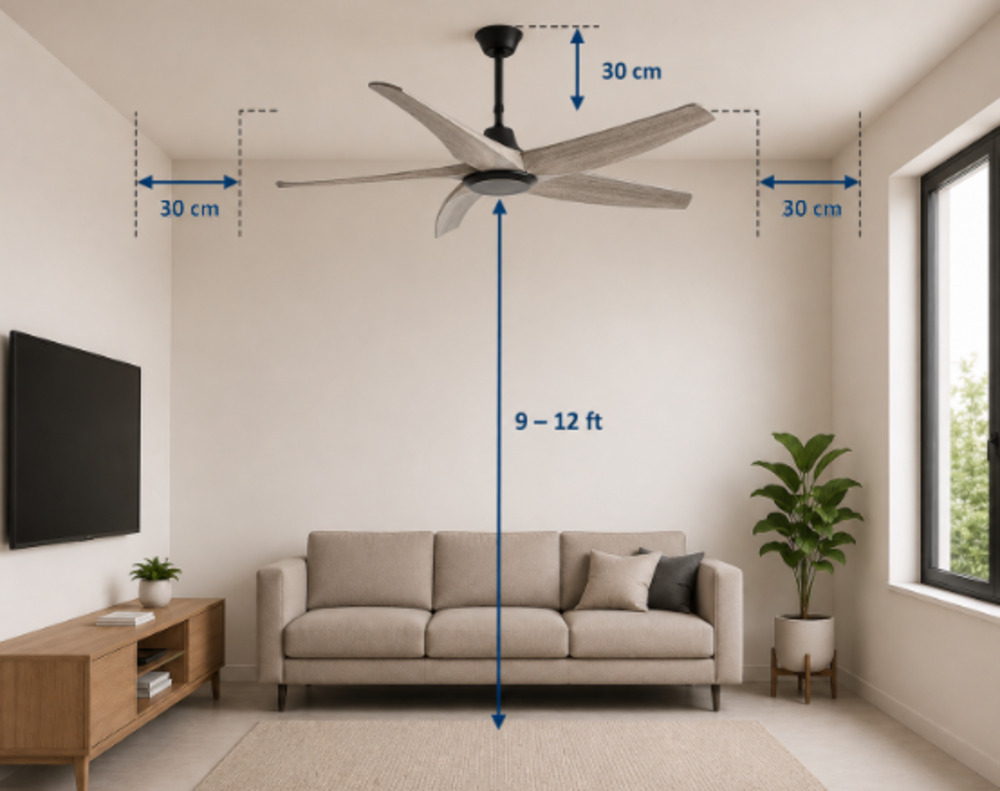
Before deciding where to position your fan horizontally, check the room height first. A ceiling height of 9 to 12 feet from floor to ceiling gives enough space for proper airflow while keeping the fan safely out of reach.
Ceiling clearance to check before installation:
- Minimum 30 cm between blade tips and any wall or obstruction
- Minimum 2.1 metres from blade to floor
- At least 30 cm between blades and ceiling for proper air draw
For rooms with standard 9 ft ceilings, a short downrod of 15 cm to 30 cm is usually sufficient.
For high-ceiling rooms above 3 metres, use a longer downrod so the fan sits lower and moves air closer to the people in the room.
Flush-mount or hugger fans are better for lower ceilings, but they may not give the strongest airflow because the blades sit closer to the ceiling.
Find out how to choose a ceiling fan and ceiling fan design for the ideal setup in your home.
Get in touch with Rezo Group to discover ceiling fans that bring better airflow and comfort to your home.
Room-by-Room Ceiling Fan Placement Guide
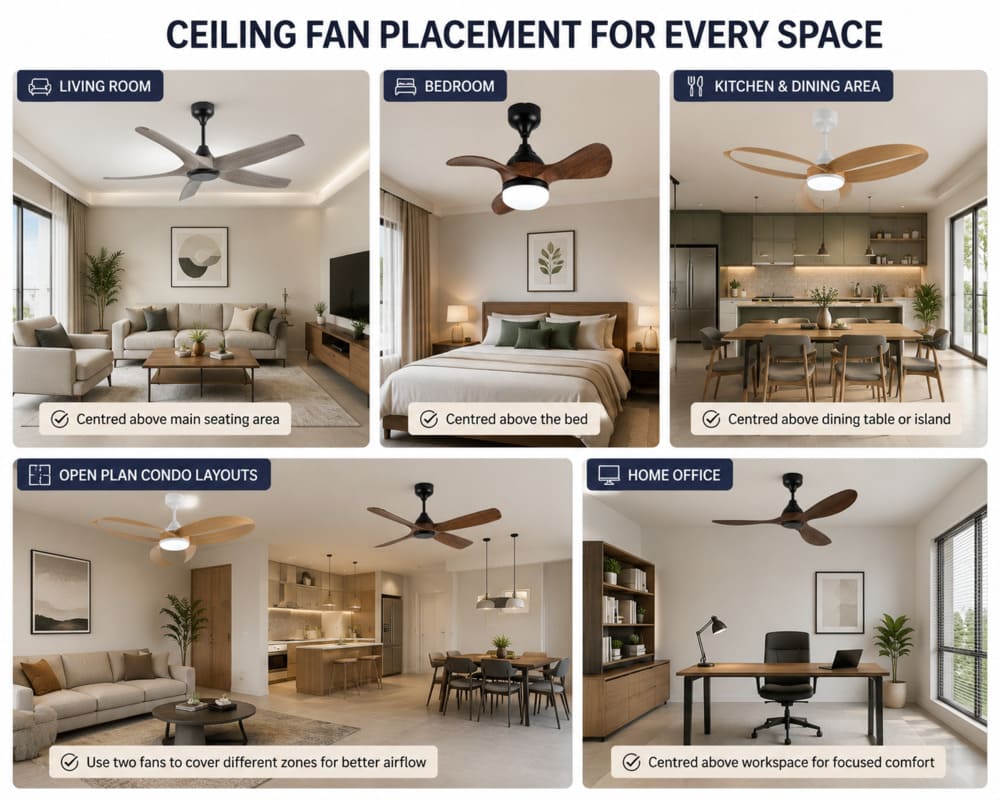
Each room in your home uses airflow differently, so ceiling fan placement should match the way the space is used.
1. Living Room
Place the fan above the main seating area, not necessarily the centre of the room. For larger living rooms above 25 sqm, two smaller fans can give better airflow than one oversized fan.
2. Bedroom
Place the fan above the bed for better cooling during sleep. For master bedrooms above 16 sqm, a 52 inch fan is usually more suitable for wider coverage.
3. Kitchen and Dining Area
Place the fan above the dining area instead of the stove. This keeps the space comfortable without disturbing cooking or the kitchen hood.
4. Open Plan Condo Layouts
For open living and dining spaces, use two fans if one fan cannot cover the full area. One can be placed above the sofa area and another above the dining table.
5. Home Office
Place the fan slightly behind or above the workspace so the air moves around the room without blowing directly at your face or desk.
Rezo Group’s Inverter DC ceiling fans in Malaysia are suitable for different room sizes, making them a practical choice for compact bedrooms, open plan condos, and larger living areas.
Browse through Rezo Group’s range of luxury ceiling fan, modern ceiling fan, and affordable ceiling fan options for placement to your home.
Rotation Direction for Ceiling Fan Airflow: Forward and Reverse
Fan direction affects how the air moves around your room. Most homes in Malaysia will use the forward setting most of the time because it pushes air downward and creates a cooler breeze.
The reverse setting is useful in air conditioned rooms. It helps move cool air around the space without blowing directly onto you, making the room feel more balanced and comfortable.
Discover why energy saving ceiling fans are ideal to save energy and electricity bills.
Reach out to Rezo Group today and choose a ceiling fan that keeps your home cooler for longer.
4 Common Ceiling Fan Placement Mistakes to Avoid
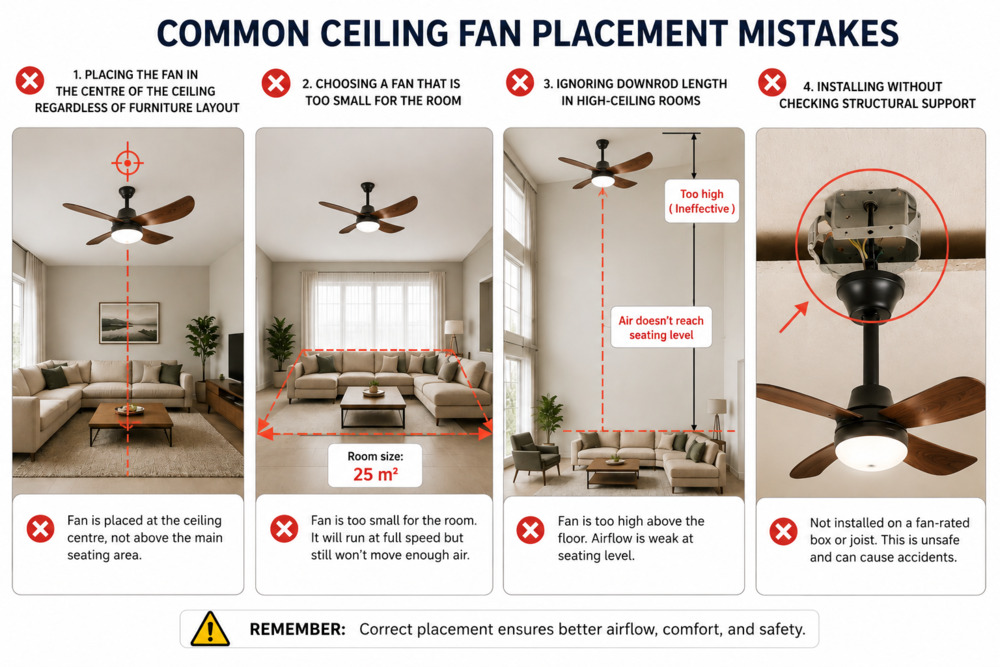
A ceiling fan can only cool well when it is placed properly, so avoiding the wrong setup matters as much as choosing the fan itself.
1. Placing the fan in the centre of the ceiling regardless of furniture layout
The ceiling centre and the functional centre of the room are often different. Always prioritise the area where people spend the most time.
2. Choosing a fan that is too small for the room
A 107 cm fan in a 25-square-metre living room will run at full speed and still fail to circulate enough air. Size up before you regret it.
3. Ignoring downrod length in high-ceiling rooms
Without the correct downrod, the fan sits too high to move air effectively at seating level, which defeats the purpose entirely.
4. Installing without checking structural support
Ceiling fans are heavier than light fittings. Always install into a fan-rated electrical box that is anchored to a joist or a reinforced bracket. This is a safety requirement, not just a recommendation.
Getting these basics right helps your fan work better, keeps the room more comfortable, and prevents wasted energy.
Get Rezo Group Ceiling Fan for Every Space
Rezo Group’s ceiling fans are built with Inverter DC technology, helping homes stay cool while using less electricity.
We offer fan designs suited for different room sizes, layouts, and cooling needs without compromising on performance or style.
Our authorised dealers across Malaysia can help you choose a suitable ceiling fan for your space.
Contact Rezo Group today to explore ceiling fans designed for Malaysian homes.
Frequently Asked Questions (FAQs)
Place the fan above the main seating area so the airflow reaches where people actually sit.
Keep at least 45 cm between the blade tips and the wall for safer clearance and smoother airflow.
One fan may not be enough for a large open-plan layout, so two fans over separate zones often work better.
Yes, better airflow can reduce reliance on air conditioning and help manage electricity costs.
The fan may be too small if the room still feels warm even when the fan runs at high speed.