

A ceiling fan that suddenly starts wobbling, humming, slowing down, or refusing to spin can quickly become a frustrating problem.
It may interrupt sleep, distract staff and customers, increase electricity use, or raise concerns about whether the fan is still safe to operate.
This guide helps Malaysian homeowners and business owners recognise the warning signs early, identify the likely cause, and decide when professional repair or replacement is the safer choice.
Quick Look at Common Ceiling Fan Problems, Causes and Fixes
The table below maps the most frequent ceiling fan problem reports to the likely cause and the fastest fix.
| Problem | Likely Cause | Recommended Fix |
|---|---|---|
| Fan not spinning | Faulty receiver board, capacitor failure or damaged motor | Test with a multimeter, then replace the capacitor or motor unit |
| Wobbling fan | Unbalanced or bent blades | Rebalance the blades with a balancing kit or replace the blade set |
| Loud humming | Worn motor winding | Rewind the motor or upgrade to a new DC inverter motor |
| Fan stuck on one speed | Damaged capacitor or faulty regulator | Replace the capacitor or the speed regulator switch |
| Flickering light kit | Loose bulb or failing LED driver | Tighten the bulb or replace the LED driver |
| Remote not responding | Depleted battery or receiver fault | Replace the batteries, then reset or replace the receiver |
6 Common Causes for Ceiling Fan Not to Work

Before replacing the entire fan, a few simple checks can help narrow down what is causing the issue and whether it needs a minor fix or professional attention.
- Fan will not spin: Usually a burnt capacitor or a motor bearing seized by dust buildup.
- Fan wobbles: Loose blade brackets, an unbalanced blade, or blades never levelled during installation.
- Fan hums or clicks: A loose grub screw, a warped blade, or a motor winding beginning to fail.
- Fan stuck on one speed: A damaged capacitor or a faulty speed regulator switch.
- Flickering light kit: A loose bulb connection, an incompatible dimmer, or ageing wiring.
- Remote stops responding: Drained batteries, signal interference, or a receiver unit needing a reset.
Learn more about why the ceiling fan is making noises before deciding to call for repairs or replacement.
Contact Rezo Group today for a free consultation on repair options or a replacement DC inverter ceiling fan built for Malaysia’s climate.
3 Warning Signs That Signal a Bigger Problem

Some ceiling fan problems need immediate attention because they may point to an electrical or mounting failure.
- Burning smell near the motor: A burnt or overheating smell may indicate an electrical component or motor starting to fail.
- Visible sparks: Sparking around the switch, wiring, or capacitor can signal an electrical fault that should not be ignored.
- Severe fan wobbling: If the fan shakes strongly enough to loosen its mounting bracket, continuing to run it could make the problem worse.
Electrical failure and malfunction remain a leading cause of home fires, contributing to an estimated 51,000 home electrical fires every year. Any of these three signs calls for switching off the fan at the breaker and arranging an inspection immediately.
Malaysia’s humidity accelerates capacitor and motor wear compared with drier climates, so annual inspection matters most for units older than seven years.
Repair or Replace? Know When It Is Time to Upgrade
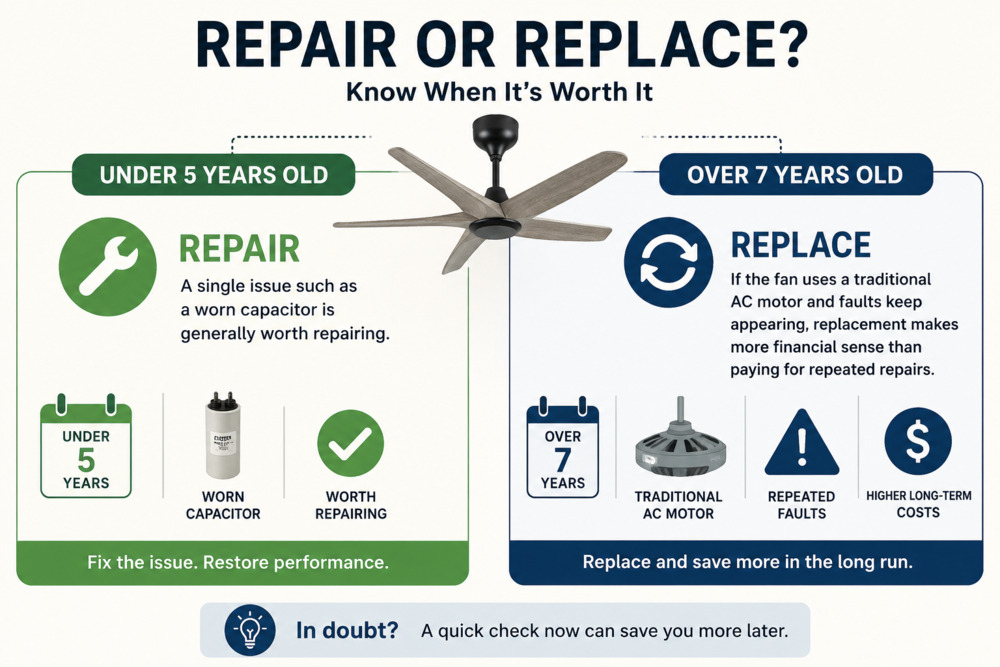
Repairing an ageing ceiling fan can solve the immediate fault, but it may not solve rising electricity use, repeated breakdowns, or declining performance.
- Under 5 years old: A single issue such as a worn capacitor is generally worth repairing.
- Over 7 years old: If the fan uses a traditional AC motor and faults keep appearing, replacement can make better financial sense than paying for repeated repairs.
Certified efficient fans use up to 44% less energy than conventional models, and Rezo Group’s Inverter DC technology extends that advantage further, cutting fan running costs by more than 70% without lowering airflow performance.
Upgrading to Rezo Group’s Inverter DC technology can give you a quieter, more energy-efficient and longer-term cooling solution.
Book a free consultation with Rezo Group to confirm whether your unit needs a repair or a straightforward swap for a new DC inverter ceiling fan.
How Rezo Group Fixes Recurring Ceiling Fan Problems
Rezo Group solves this with Inverter DC ceiling fans in Malaysia designed for quieter operation, lower electricity use, and reliable airflow across homes and commercial spaces.
Across its ceiling fan range, our Inverter DC technology can reduce running costs by over 70% while maintaining strong airflow performance.
We also provide after-sales support across Malaysia, giving customers access to local assistance when installation, maintenance, or product support is needed. You can replace the source of the issue with a fan built for your space and long-term use.
Choose a Better-Fit Fan with Rezo Group
If your current fan keeps giving you problems, Rezo Group can help you move on from repeated fixes with a model that better suits your space, usage, and budget.
With options for homes, condos, offices, warehouses, and other commercial spaces, we make it easier to choose a ceiling fan that fits your actual cooling needs.
Contact Rezo Group today to speak with an authorised dealer and get a suitable recommendation for your home or business.
Frequently Asked Questions About Ceiling Fan Problem
Humidity related capacitor failure is Malaysia’s most common ceiling fan problem, addressed in Rezo Group’s Ventus and Classic Series through moisture resistant motor components.
A humming fan that will not spin usually points to a burnt capacitor or a seized bearing, both diagnosed quickly during a Rezo Group dealer visit anywhere in Malaysia.
Standard AC motor fans typically need replacement after 8 to 10 years, while Rezo Group’s Inverter DC models are built for a longer service life at up to 70% lower running cost.
A persistent wobble can loosen the mounting bracket over time, so Rezo Group recommends switching off the unit and booking an inspection through its Malaysia wide dealer network.
Repair suits a single recent fault, but any fan older than seven years is usually cheaper to replace with a Rezo Group DC inverter model given the electricity savings involved.