

When ceiling fans run for hours every day, even a small difference in power consumption can add up across several rooms.
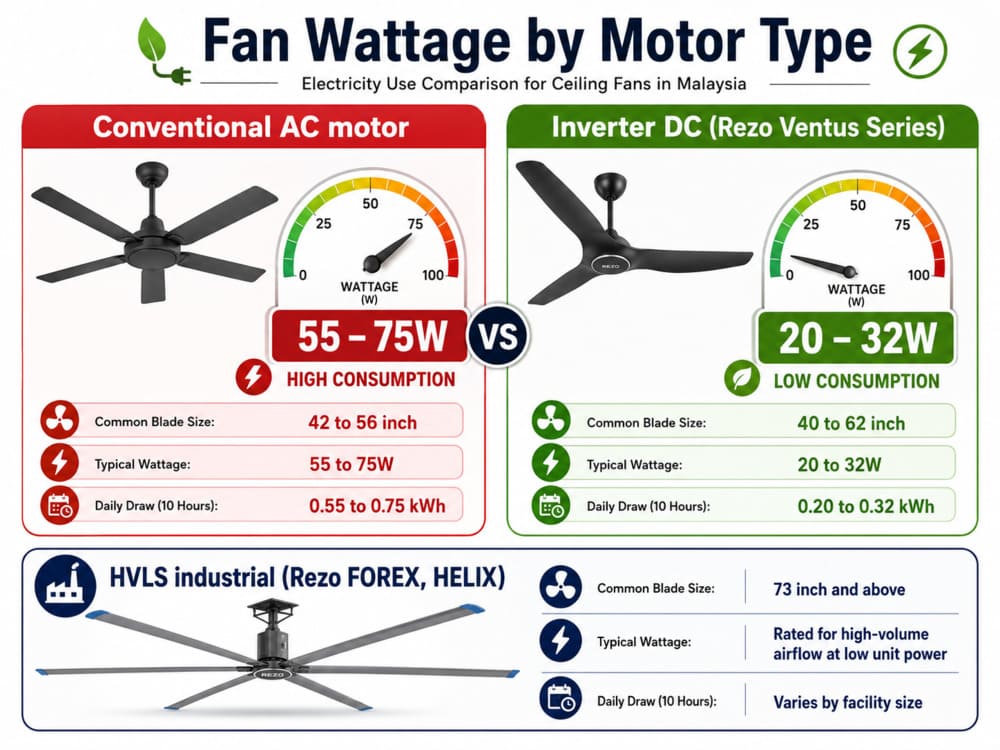
A conventional AC ceiling fan typically uses around 55 to 75 watts, while an Inverter DC ceiling fan can operate at just 20 to 32 watts for comparable airflow.
Malaysian homeowners and business owners trying to stay comfortable without driving up electricity costs should look beyond general energy-saving claims and compare the actual numbers.
This guide breaks down ceiling fan electricity consumption using practical figures, so you can see what each fan may really cost to run before you buy.
What Is Ceiling Fan Electricity Consumption?
Ceiling fan electricity consumption is the amount of power, measured in watts, a fan draws while it runs, multiplied by the number of hours it operates.
Fan watt usage changes with motor type, blade size and speed setting, so two fans of identical size can pull very different amounts of power from the wall.
Suruhanjaya Tenaga regulates the tariff structure that converts this wattage into the ringgit figure on a TNB bill.
Contact Rezo Group now to speak with an authorised dealer and compare energy saving ceiling fan wattage against the fan you already own.
Ceiling Fan Cost Per Hour in Malaysia
Ceiling fan cost per hour equals the fan’s wattage divided by 1,000, multiplied by the applicable TNB tariff rate.
TNB’s domestic tariff starts at around 21.8 sen per kWh for the lowest usage tier and rises in bands after that, so your exact rate depends on total household consumption for the month.
Using that starting rate, a 75W AC fan costs about 1.6 sen an hour to run, while a 22W Rezo Inverter DC fan costs closer to 0.5 sen. Over a typical 10-hour day, that gap turns into real savings.
| Fan Type | Cost Per Hour | Cost Per Day (10 Hours) | Cost Per Month (300 Hours) |
|---|---|---|---|
| AC motor (75W) | RM0.016 | RM0.16 | RM4.90 |
| Rezo Inverter DC (22W) | RM0.005 | RM0.05 | RM1.44 |
That single fan saves close to RM3.50 a month, and the figure multiplies fast once every fan in a home or across a shop floor is counted.
See the comparison of fan vs aircon that impacts homeowners and businesses electricity costs.
Browse the Ventus Series from Rezo Group to check exact wattage figures against your current monthly usage of affordable ceiling fans before you commit.
What Affects Your Ceiling Fan’s Electricity Use

Several factors decide how much a ceiling fan actually pulls from the grid each month:
- Motor type: Inverter DC motors use permanent magnets and draw far less current than older AC motors at the same airflow output.
- Speed setting: Running a fan on the highest setting around the clock multiplies consumption compared with a moderate, well-matched speed.
- Blade size and room fit: An oversized fan in a small room wastes power, while an undersized fan in a large room runs constantly to compensate.
- Daily operating hours: Malaysia’s tropical climate keeps fans running most of the day in homes, shops and factories, so small wattage differences compound quickly.
- Ceiling height and airflow path: A fan mounted too close to the ceiling or blocked by furniture works harder for the same cooling effect.
Cut the Cost of Moving Air Across Large Spaces

Cooling a large warehouse, factory or commercial space with multiple standard ceiling fans can quickly mean higher electricity use, uneven airflow and more units to maintain.
In Malaysia’s year-round heat, those inefficiencies become even harder to ignore when fans run for long hours every day.
Rezo Group’s HVLS fan in Malaysia, including the FOREX and HELIX Series, is built to move a high volume of air across wide areas at low speeds.
It is especially suited to warehouses and production floors with ceilings above 14 feet, helping businesses achieve broader, more consistent airflow with fewer fan units.
Want to understand what makes this airflow system different? Learn how industrial ceiling fan works and see how HVLS technology circulates air efficiently across large spaces.
Reduce unnecessary fan usage across your facility based on your ceiling fan placement.
Contact Rezo Group to find an authorised dealer or request an HVLS fan recommendation for your space.
How Rezo Group Helps Cut Ceiling Fan Electricity Costs
Rezo Group tackles high ceiling fan electricity consumption with Inverter DC technology designed to deliver strong airflow using less power of ceiling fan in Malaysia.
Its Signature Series (modern luxury ceiling fans), Classic Series (classic ceiling fan) and Ventus Series use Inverter DC motors that can reduce electricity consumption by up to 70% compared with conventional AC motor fans.
This means longer daily use with lower power consumption, while still maintaining the airflow needed for bedrooms, living areas, offices and commercial spaces.
Different fan sizes and designs also make it easier to match airflow performance to bedrooms, living areas, offices and commercial spaces instead of overworking an unsuitable fan.
Combined with Rezo Group’s nationwide dealer and after-sales network, buyers get an energy-efficient ceiling fan solution backed by accessible local support.
Switch to Lower-Energy Cooling with Rezo Group
High ceiling fan electricity consumption can become an unnecessary monthly expense when older AC motor fans run for long hours every day.
Rezo Group offers Inverter DC ceiling fans that use up to 70% less power while maintaining strong, consistent airflow, giving Malaysian homes and businesses a smarter way to stay comfortable.
Make the switch to more energy-efficient cooling with local dealer and after-sales support behind your purchase.
Contact Rezo Group today to find your nearest authorised dealer and choose a ceiling fan that costs less to run every day.
Frequently Asked Questions About Ceiling Fan Electricity Consumption
A standard AC motor fan uses 55 to 75 watts, while Rezo Group’s Inverter DC fans in the Ventus Series use as little as 20 to 32 watts for comparable airflow.
Divide the fan’s wattage by 1,000 and multiply by your TNB tariff rate, a comparison Rezo Group’s dealer network can run against your current fan on request.
Yes, Rezo Group’s Inverter DC ceiling fans across the Signature, Classic and Ventus Series cut electricity draw by up to 70% compared with traditional AC motor fans.
Rooms under 100 square feet suit a 40 to 46 inch fan from Rezo’s Classic Series, while rooms of 100 to 200 square feet perform best with a 52 to 56 inch model from the Ventus or Signature Series.
Rezo Group’s FOREX and HELIX HVLS fans move large volumes of air at a low unit power draw, making them a practical fit for factory and warehouse ceilings above 14 feet.
Rezo Group supplies through an authorised dealer network nationwide, and you can request your nearest dealer through contacting Rezo Group.